Trade-In & Financing Rates in Hazelwood, MO: 2026 Guide
How to read a trade-in offer and APR together on the same deal in Hazelwood, MO — equity math, Missouri tax impact, and what to verify before signing.
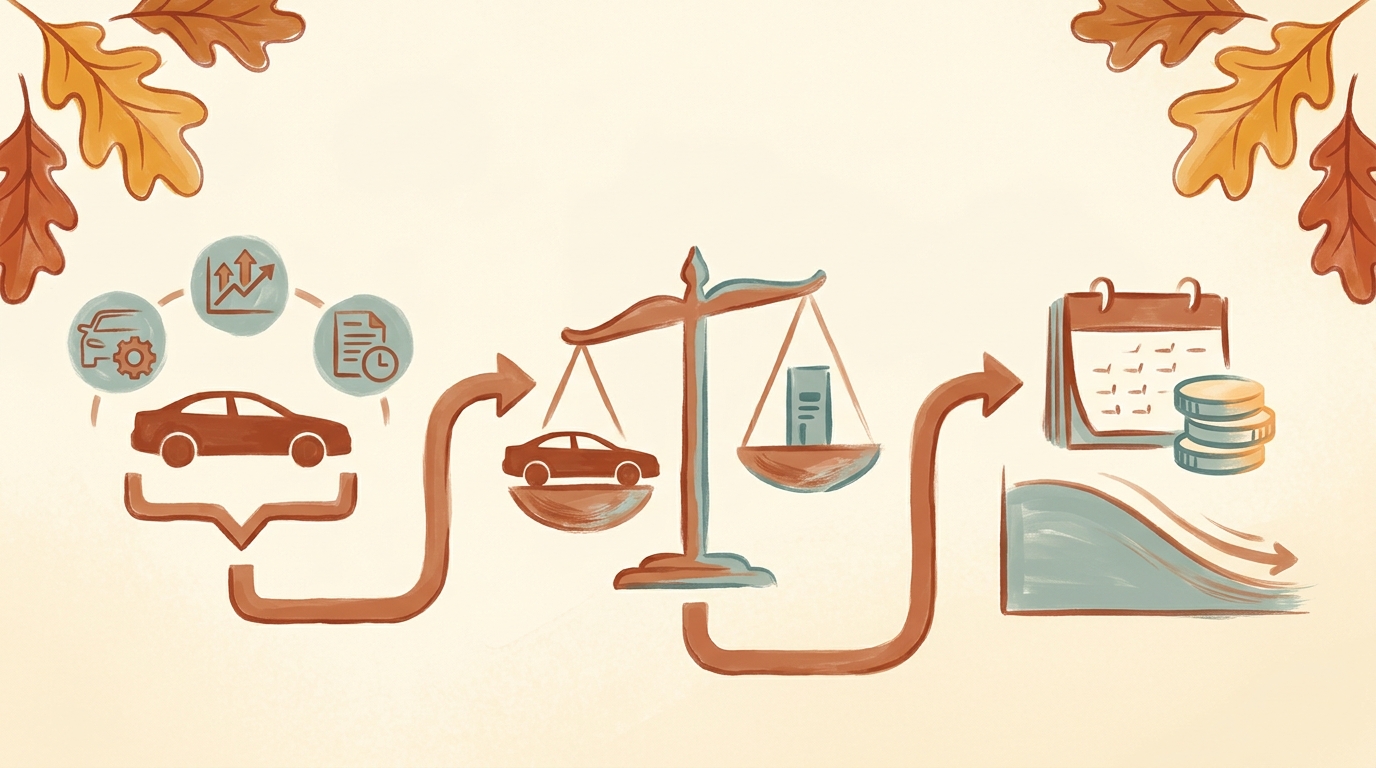
To compare a trade-in offer and a financing rate at a Hazelwood dealership, read them as one connected deal: subtract your loan payoff from the trade allowance to find your equity (or shortfall), then see how that figure changes the amount financed, the APR you qualify for, and the total of payments on the new loan. The APR alone will not tell you what the deal costs — the trade number feeds directly into the loan principal, and in Missouri it also reduces the taxable base of the new vehicle.
Why do trade-in value and APR have to be read together in Hazelwood?
Trade-in and financing are not separate transactions — they share one buyer's order. The trade allowance minus your payoff becomes equity added to your down payment, or negative equity rolled into the new loan. That change in principal, combined with the APR and term, determines what you actually pay. Reading one without the other hides the real cost.
A strong APR on a loan that quietly absorbs a $2,500 shortfall from your old car is not a strong deal. A generous trade allowance paired with a longer term and higher APR can cost more over the life of the loan than a smaller allowance at a shorter term. The only way to see this is to put the full itemized buyer's order on the table — trade allowance, payoff, equity or shortfall, amount financed, APR, term, and any optional add-ons — and read the lines together. Bommarito Ford Superstore Hazelwood, at 675 Dunn Rd just off I-270 in north St. Louis County, handles both halves of the deal in one place, which makes it easier to see how a change in one number moves the other.
How do you calculate equity or negative equity on a trade?
Equity equals your trade-in allowance minus your current loan payoff. If the allowance is higher, the difference becomes a credit toward the new vehicle. If the payoff is higher, the shortfall is negative equity — according to the FTC, dealers may add that shortfall to the new car loan, take it from the down payment, or both, meaning the buyer pays interest on it along with the new car.
Two cautions. First, per CFPB guidance, the payoff amount on your existing auto loan can differ from the balance printed on a statement or coupon book because of how interest accrues and any outstanding late fees or charges — call your lender for a 10-day payoff quote before you shop. Second, the FTC illustrates the mechanic with a car worth $15,000 against an $18,000 loan balance, leaving $3,000 in negative equity that commonly gets rolled into the new loan. Rolling that balance in, according to the CFPB, increases total loan costs and the interest paid over the life of the new loan.
A quick worked example
If a Hazelwood dealer offers a $14,000 trade allowance and your payoff is $16,500, you have $2,500 in negative equity. If that negative equity is added to a new loan on a vehicle you were already planning to finance, both your monthly payment and total interest go up. The APR did not change; the principal did, because of the trade.
How does Missouri sales tax change the trade-in math?
In Missouri, sales or use tax on a dealer purchase is generally calculated on the purchase price minus the documented dealer trade-in allowance — the trade reduces the taxable base rather than being paid out in cash. That means a higher trade allowance also lowers the tax you owe on the new vehicle, so the "real" value of a trade credit at a Hazelwood dealership is the allowance plus the tax it offsets. Verify current treatment with the Missouri Department of Revenue.
Missouri also allows a credit for a private vehicle sale when the sale and the replacement purchase occur within 180 days of one another — a separate process from a dealer trade-in, with its own documentation. If you are weighing "trade it in" versus "sell it privately and buy from the dealer," the length of time between the sale and the purchase determines whether the private sale is tax-comparable; outside that window, the dealer trade-in is usually the only way to capture the tax offset. Confirm current documentation requirements with the Missouri Department of Revenue before you rely on either path.
How do you read the APR, term, and total of payments together?
APR represents the yearly total cost of borrowing, including interest and fees — not just the rate on the principal. Before signing, read the APR against the loan term and the total of payments on the federal lending disclosure the dealer provides. A lower monthly payment often means a longer term and more interest paid overall; a higher APR on a shorter term can cost less in total.
Two amortization points matter for the comparison. In the early stages of an amortized loan, a larger portion of each payment goes toward interest, while later payments increasingly reduce the principal — which is why stretching the term to lower a payment can leave you upside-down again in two or three years. And a fixed interest rate stays the same for the life of the loan; a variable rate moves with a benchmark such as the prime rate, changing the payment over time. Most retail auto loans are fixed, but confirm which you are being quoted.
What should the buyer's order show before you sign?
Ask for a written, itemized buyer's order with these lines separated, not blended into a single "out-the-door" number: trade-in allowance, loan payoff, equity or shortfall, cash down, documented sales tax calculation, amount financed, APR, term in months, total of payments, and every optional product (service contract, GAP, paint protection, etc.) as its own line. Each line should be a number you can question or decline.
- Trade allowance vs. payoff: confirm the payoff figure matches your lender's current payoff quote, not a statement balance.
- Taxable base: confirm Missouri sales tax is calculated on price minus the documented trade allowance.
- Amount financed: verify it equals vehicle price + tax + fees + any rolled negative equity − cash down − trade credit.
- APR, term, total of payments: compare across any competing offers on the same term length, not just by monthly payment.
- Add-ons: each optional product is optional — ask the price of the loan without it to see the real cost.
The FTC also notes that if a dealer tells you they will pay off your trade themselves but actually rolls that cost into the loan, that is illegal — so the payoff line on the buyer's order should match what the dealer actually sends your old lender. Per CFPB guidance, contact the old lender after signing to confirm the previous loan has been paid off.
How should you compare offers across Hazelwood dealerships?
Compare the full itemized buyer's order from each dealer on identical terms — same loan length, same cash down, same optional products included or excluded. Line the numbers up side by side: amount financed, APR, total of payments, and the trade allowance net of your payoff. The dealership with the best headline on any single line is often not the one with the best total cost.
Side-by-side comparison template
| Line item | Dealer A | Dealer B | What to check |
|---|---|---|---|
| Trade-in allowance | $ | $ | Compare to KBB, Edmunds, NADA, Consumer Reports estimates |
| Documented loan payoff | $ | $ | Use your lender's 10-day payoff quote |
| Equity (+) or shortfall (−) | $ | $ | Allowance minus payoff |
| Missouri sales tax base | $ | $ | Price minus documented trade allowance |
| Amount financed | $ | $ | Includes any rolled negative equity |
| APR / term (months) | % / mo | % / mo | Compare on same term length |
| Total of payments | $ | $ | The real cost comparison |
| Optional add-ons | $ | $ | Each line is optional |
Trade-in estimates can be researched through Consumer Reports, Edmunds, Kelley Blue Book, and NADA Guides, and buyers can get offers from multiple dealerships and negotiate. Factors that move the number include mileage, overall condition, market demand for the make and model, and your negotiating approach — and cars tend to depreciate fastest during the first five years of ownership, which is why timing a trade matters as much as which dealer you take it to. Dealers calculate a trade's actual cash value (ACV) based on market conditions, mileage, overall condition, and model popularity, and daily price fluctuations mean the same car can carry a different number on a different week.
"For the first time in a long time, I felt like this was a very, very fair deal. They gave me Kelley Blue Book for my car and gave me a good deal on the vehicle. I’m very happy. See Steve!" — 5★ · Bob, Oct 2026
Frequently asked questions
Should I negotiate the trade-in and the new vehicle price separately?
Yes. Agree on the new vehicle price first, then the trade allowance, then the financing — each as its own number. Blending them into a single "difference" or monthly payment hides where margin is moving. Once the three numbers are set individually, the itemized buyer's order will show how they combine into amount financed, APR, and total of payments.
Is a longer loan term worth it to lower my payment?
Usually not for total cost. A longer term lowers the monthly payment but increases total interest, and because early payments go mostly to interest, you stay in negative equity longer. If you plan to trade again in three or four years, a longer term can leave you underwater on the next deal. Compare APRs on the same term length to see the real cost difference.
How do I know the dealer actually paid off my old loan?
Follow the CFPB's guidance: wait about one week after signing and contact your old lender to confirm the previous loan has been paid off. Keep the signed buyer's order showing the payoff amount the dealer agreed to send. If the dealer promised to pay off the trade but rolled the cost into the new loan without disclosure, review the payoff line on the buyer's order carefully to confirm what the dealer actually sent your old lender.
Does Missouri tax my new vehicle on the full price or the price after trade?
Missouri generally calculates sales or use tax on the purchase price minus the documented dealer trade-in allowance, which reduces the taxable base rather than paying out cash. Confirm the exact treatment with the Missouri Department of Revenue, and make sure the trade allowance is written on the buyer's order — a trade credit that is not documented will not reduce your tax.
What if my trade is worth less than I owe?
That is negative equity. The FTC illustrates it with a car worth $15,000 against an $18,000 loan balance, leaving a $3,000 shortfall. A dealer may roll that shortfall into the new loan, take it from your down payment, or both. Rolling it in increases total loan costs and the interest paid over the life of the new loan, per CFPB guidance — ask whether delaying the purchase or increasing cash down is more cost-effective.
Can I get a trade quote without committing to buy?
Yes. Buyers can obtain trade-in estimates from multiple dealerships and negotiate the trade-in value separately from a purchase. Bring your title or registration, current odometer reading, and your lender's current payoff quote. Written appraisals typically have a short validity window because ACV reflects daily market conditions, so plan to compare offers within the same week.
Putting it together
The deal that reads best on paper is almost never the deal with the lowest headline APR or the highest headline trade number — it is the deal where the itemized buyer's order, read line by line, produces the lowest total of payments for the term you actually want. Hazelwood shoppers who want this handled in one place, with the trade appraisal, financing, and Missouri tax calculation on the same written buyer's order, can reach Bommarito Ford Superstore Hazelwood at (314) 895-0600 or https://www.bommaritoford.com/ to start the conversation.